El Alamein
Guide to visiting El Alamein
“Before Alamein we never had a victory. After Alamein we never had a defeat” – Winston Churchill
Located some 120KM west of Alexandria, the area around El Alamein is the site of one of the most gruesome and decisive battles of World War II.
The Site
The El Alamein complex is spread over several kilometres and includes the following:
The El Alamein Museum – The El Alamein Museum houses an extensive collection of the tools of desert warfare divided over several rooms dedicated to the artefacts of the German, Italian and Commonwealth Armies respectively.
Uniforms, weapons, maps and more are neatly exhibited among manikins and descriptive plaques (in Arabic and English).
A three dimensional map dominates the main hallway. Flashing LEDs, a raspy audio and a man with stick provide visitors with a ‘visual’ depiction of the back and fourth of Al Alemain.
The museum is surrounded by a collection of rusty desert war vehicles including a multitude of tanks, artillery guns and a decimated spitfire.
Entrance to the Museum is 20LE per person with additional premiums in place for the use of camera/video equipment.
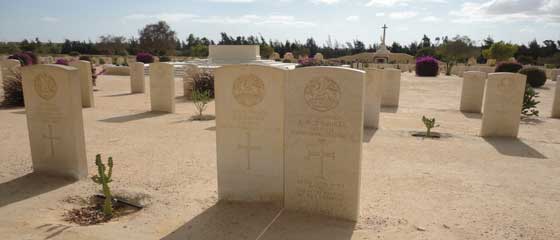
The El Alamein Cemeteries – The site has three commentaries spread over several kilometres the grounds of which have been donated by the Egyptian government, the most extensive being that of the commonwealth fighters.
Located 1Km east of the Museum, multiple rows of neatly plotted headstones remembers those Commonwealth soldiers that lost their lives.
TThe Italian and German memorials are located 2km west of the museum. Each army has a mausoleum dedicated to all the soldiers that are buried beneath them.
Getting to El Alamein
Al Alamein is 2 hour drive west of Alexandria on a route that skirts the salt lakes behind the city before continuing on the desert road that runs parallel to the sea and the seemingly endless row of resorts that stand at its shore.
Although the journey can be made by bus or service taxi (shared taxi), visitors need transport to get between the cemeteries if they wish to see them all. The museum and commonwealth cemetery are close enough to walk (1KM). /p>
Alternatively via private taxi hire, the return journey from Alex should cost no more than 400-500LE maximum.
Although there is a shop cum café at the museum which sells snacks and half decent coffee, do bring some food for lunch as there is currently a lack of decent options on route.
DDon’t wander off the cleared roads or paths around the cemeteries as their remains unexploded ordinance and land mines in the area.
History of El Alamein
The allied victory at El Alamein over the Germans – lead by Erwin Rommel - and Italian troops was critical in retaining control of the Mediterranean and halting the Nazi advancement to Alexandria and in turn, the Suez Canal.
Between 1940 – 1942 the Axis Armies (Germany and Italy) advanced and then retreated a number of times over various bloody battles across North Africa in what the site’s museum terms, ‘The Strategic See-Saw’ of desert warfare. /p>
By 1942, Rommel had advanced his armies to El Alamein. On the 1-2 July 1942 Rommel attacked the allied defensive line but was driven back. The allies counterattacked but failed to obtain a decisive victory.
The second and final battle of El Alamien was to steer the course of the war.
Fought between the 23 October and the 4th November 1942, operation ‘light foot’ resulted in the full retreat of the axis armies and the end of their North African campaign.
It is estimated that more than 44,000 souls lost their lives fighting at El Alamein.
For More Information:
War Graves Commission Commonwealth - El Alamein