St Paul's Monastery
This page contains information on the History of St Anthony, What to see, and How to get there
History
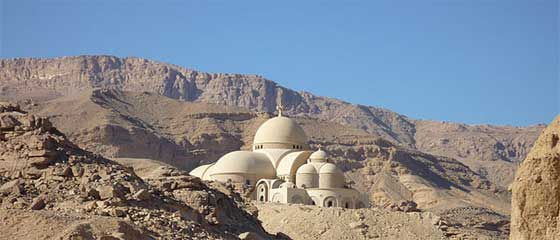
St Paul's Monastery is located in the Eastern desert, a little way off the main road linking Hurghada to Suez.
The monastery was built to celebrate the life of St Paul of Thebes, not be confused with St Paul the apostle, who at age sixteen was Egypt’s youngest known hermit.
Like his friend and counterpart St Anthony, St Paul was also born into a wealthy family but lost his parents at a young age. Fearing persecution in Alexandria, he fled to the eastern desert where he enjoyed a pious yet solitary existence in a cave.
Having heard that a man even more devout than himself existed in the same region, St Anthony set out to find St Paul, and later the two of them became friends.
According to the story, sensing his own death was imminent (he was well over 100 after all), Paul begged Anthony to fetch the robe of Pope Anthanasius for him to be buried in. Anthony dutily obliged but when he returned with the robe Paul was already dead.
Lions appeared and dug a grave for Paul and as promised Anthony dressed Paul's corpse in the tunic he had request. Paul’s own tunic was given to the pope who wore it on Christmas and Easter.
Paul’s followers built the monastery around the cave where he had lived. Like St Anthony's Monastery, it was ransacked several times over the centuries by marauding Bedouin tribes.
What to see?
St Paul’s Monastery is significantly smaller and less impressive than St Anthony’s. There are four churches on the site including the cave church of St Paul at its centre. It is here that Paul’s remains are kept.
Like most ancient monasteries in Egypt, the site is protected by impressive, fortified castle like walls.
Opening time
The monastery is open from 9am – 5pm each day except during Christmas or Lent. Conservative clothing should be worn with knees and shoulders covered at all times on the site.
How to get to St Paul’s Monastery?
The turn off for St Paul’s monastery is located 26km south of Za’frana on the main road between Suez and Hurghada. From here the monastery lies another 13km up well paved road.
No direct public transport currently exists so visitors have the following options.
1) Join a tour group from Cairo or Hurghada. The most frequent minibuses from Cairo are operated by pilgrim tours if you don’t mind travelling with pious believers. Allow a full day for the return trip which is often combined with a visit to St Anthony’s monastery a 90 minute drive away.
2) Find some fellow travellers and hire a service taxi (intercity taxis) from Cairo or Suez or Hurghada. The return trip should cost between 70 – 100€ depending on how long you intend to stay, if you also visit St Anthony’s Monastery, and how good your bartering skills are.
3) Take a public bus from Cairo or Suez to Hurghada. Ask to be dropped off at the turning for the monastery. From here it’s a 13km uphill hike to the monastery. Summer months are best avoided for this option. Hitching is also an option along this route.
4) If you are coming from St Anthony’s monastery it is possible to hike to St Paul’s. The trail is demanding however and it’s recommended that you acquire a guide for the trip (more easily available at St Paul’s).
For More Information:
Wikipedia - for more history on St Paul's Monastery or St Paul of Thebes