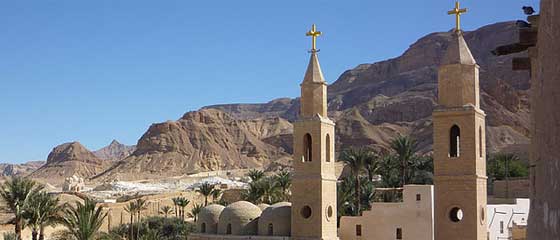
St Anthony's Monastery
This page contains information on the History of St Anthony, What to see, and How to get there
History
Located in Eastern desert, some 50km from the red sea coast, St Anthony’s Monastery is the largest and oldest Coptic monastery in Egypt.
St Anthony was born just a short distance away in Beni Suef in AD250 to a wealthy family. His parents died when he was young and left him guardian to a little sister.
At the age of 34 he chose to follow the words of Christ and dedicated his life to asceticism. He distributed his wealth and assets to the poor and retreated to the desert where he adopted a hermit’s life.
In AD311, at a time when Christians endured widespread persecution, Anthony travelled to Alexandria and formally confessed his faith to the governor there.
Anthony was not made a martyr as had been his intention, and was left instead free to leave Alex and return to the desert.
However this act earned him thousands of followers who later visited him for wisdom and teachings.
St Anthony died at the tender age of 105 and was buried at his request, in an unmarked grave.
The Monastery was founded by his disciples in 4th century AD just a short distance beneath the cave where St Anthony lived.
The Monastery thrived between the 12th – 15th centuries when monks spent time here translating theological works into Arabic.
In 1483 Bedouins plundered the monastery and killed or expelled the majority of its monks.
What to See?
Although some parts of the monastery remain off limits to tourists, visitors are usually treated to a guided tour by an English speaking monk. Highlights include the library which contains a vast body of manuscripts, a bakery, a museum dedicated to the history of the site, and the five ancient churches located within the vicinity.
Located 2km away up 1200 steps is St Anthony’s cave. The 45 minute trundle up 276m is well worth it for the breathtaking views across the wadis and out to the red sea.
Opening times
The monastery is open from 9am – 5pm each day except during Christmas or Lent. Conservative clothing should be worn with knees and shoulders covered at all times on the site.
How to get to St Anthony’s Monastery?
St Anthony’s monastery is located 15km from the turn off from the main road between Beni Suef and Za’Frana, about 33km from Za’frana.
No direct public transport currently exists so visitors have the following options.
1) Join a tour group from Cairo or Hurghada. The most frequent minibuses from Cairo are operated by pilgrim tours if you don’t mind travelling with pious believers. Allow a full day for the return trip which is often combined with a visit to St Paul’s monastery a 90 minute drive away.
2) Find some fellow travellers and hire a service taxi (intercity taxis) from Cairo or Suez or Hurghada. The return trip should cost between 70 – 100€ depending on how long you intend to stay, if you also visit St Paul’s, and how good your bartering skills are.
3) Take a public bus to Za'frana and then a service taxi from Za'frana to Beni Suef. Ask to be dropped off at the turning for the monastery. From here it’s a 15km uphill hike to the monastery. Summer months are best avoided for this option. Hitching is also an option along this route.
4) If you are coming from St Paul’s monastery it is possible to hike to St Anthony’s. The trail is demanding however and it’s recommended that you acquire a guide for the trip (more easily available at St Paul’s).
For More Information:
Wikipedia - More info about the histories of St Anthony's Monastery and St Anthony the great